

Botswana Honeymoon Safari Holidays Reviewed
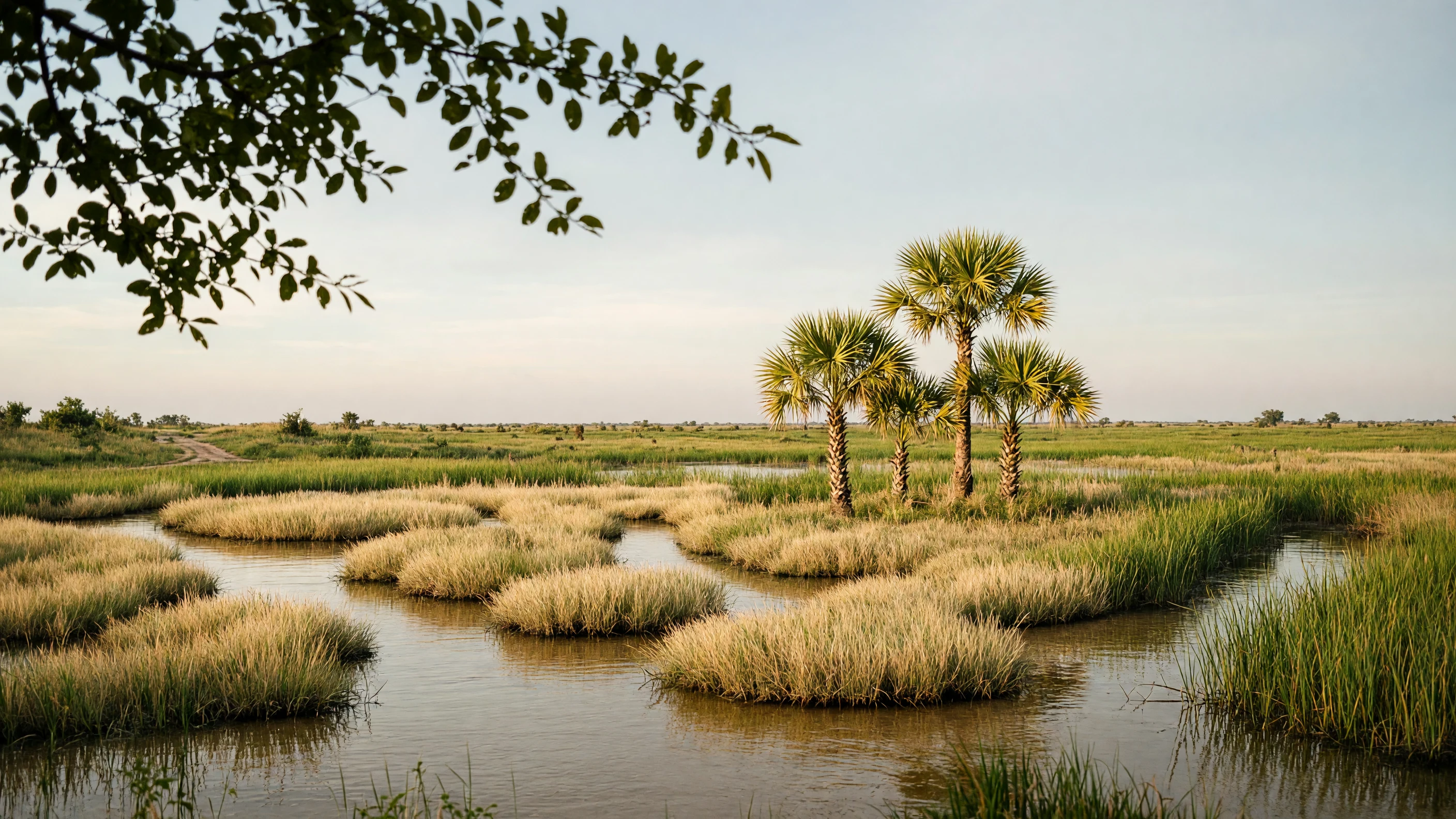
The light over the Okavango Delta at six in the morning is the colour of weak tea, and you'll be awake for it whether you planned to be or not, because the francolins start up about twenty minutes before the sun clears the palms. Botswana honeymoon safari holidays reviewed honestly tend to skip the birds. Most packages sold as romance lead with the outdoor bath and the champagne on arrival. Those things exist. The birds are what you actually remember from the first morning.
Here's the shape of a typical ten-night honeymoon: three nights in the Okavango, three in the Linyanti or Chobe, two in the Kalahari, and a night at each end in Maun or Kasane. That's the standard circuit and it works. You fly between camps in six-seater Cessnas, which cuts out the long transfers, and you'll pay for that convenience in baggage allowance.
Fifteen kilos each, soft bags only, no wheels. If your packing leans towards three pairs of shoes, you'll be repacking on the floor of a Maun guesthouse at seven in the morning while a driver waits. Buy a soft duffel before you fly. It's a dull piece of advice and it saves an argument.
What you're actually paying for
Prices run from about £450 per person per night at the simpler delta camps to well over £1,500 at the top end, and the difference is rarely the wildlife. It's the size of the room, whether the vehicle has three rows of seats or two, and how many other guests share your guide. A camp with six tents sends two people per vehicle. A camp with twenty tents fills four vehicles, so you spend the morning in radio contact with three other guides.
Shoulder season, roughly November and then April to June, knocks 30 to 40 per cent off high-season rates. I'd say the trade-off is worth it in April, when the pans hold a little water and the light is softer, though I'm not certain the same holds in November, when the first rains make the roads unpredictable and some camps close altogether.
You don't need to book the most expensive camp on the list. You need a camp with a guide who'll stop the vehicle for twenty minutes to watch a squirrel, because that's the temperament that finds you a leopard an hour later.
Water or dust: pick your season
The delta floods in the dry season, which sounds backwards and isn't. Water from the Angolan highlands arrives in June and peaks in July and August, so the Okavango is fullest when the rest of Botswana is at its driest. That's when you get the mokoro trips and the reed channels, plus herons standing about in the shallows.
October is hot. Forty degrees by mid-afternoon, and the afternoon game drive gets shortened because nobody, animal or human, is doing much between two and four. It's also the best month for predators near water, so people put up with it. Take a second water bottle and a hat with a brim.
If what you want is a boat and a helicopter and a mokoro all in one trip, come in July. If what you want is green grass, calves everywhere and a lower bill, come in December and accept that some roads turn to soup.
The best honeymoon safari is not the most expensive one. It's the one where you and your partner have the same amount of patience at four in the afternoon.
Camp life and the parts nobody mentions
Days run on a fixed rhythm: wake at five, coffee and a biscuit, out by five thirty, back by nine for brunch, sleep until three, tea, out again until seven, dinner at eight, bed by nine thirty. You'll be tired in a way that feels earned. Two people who normally go to bed at midnight will find themselves asleep before the plates are cleared.
The food is better than it has any right to be, given the logistics. I had a lamb shank in a camp four hours from the nearest tar road that I still think about. The coffee is generally terrible.
Wi-Fi exists at most camps but it's slow and often confined to the main area, which is a polite way of saying the lounge. Nobody tells you that the hot water in some tented camps runs on a wood boiler, so your shower is hot at seven and lukewarm by eight. My first shower at a delta camp was cold, my second was hot, and I never worked out the pattern.
Then there's the small stuff. The canvas walls let in every sound, including the honey badger that went through the rubbish bins at two in the morning and the couple two tents over having a loud, unresolved conversation about whose turn it was to carry the camera bag. Bring earplugs. It's not romantic. It's necessary.
Scheduled activities are split between the two of you and other guests, which is fine in the vehicle and less fine at dinner, when you're seated at a long table with six strangers and the conversation turns to everyone's flight connections. Some camps offer private vehicles for an extra £250 to £400 a day. If you're the sort of couple who needs the option of not talking, pay it.
Okavango, Linyanti, Kalahari: which order
Most itineraries start wet and end dry. Three nights in the delta, three in Linyanti or Chobe for elephants and river, two or three in the Kalahari for the black-maned lions and the open pans. It's a sensible progression and the flights work.
You could do it the other way round. Starting in the Kalahari means you spend your first two days in a landscape so empty it takes a while to adjust to, and then the delta feels like a reward. The downside is that you're flying into a remote airstrip from Maun on day one, when you're still tired and your bag hasn't arrived.
If you can only do two camps, cut the Kalahari rather than the delta. The Kalahari is extraordinary, but three days of small distances and long silences strains some people.
What a good day looks like
You wake before the alarm. Coffee in a tin cup. The vehicle smells of diesel and dust and the seat covers are cold. Twenty minutes out of camp the guide stops, switches off the engine, and you sit there while a herd of elephants crosses the track at their own pace, trunk to tail, the smallest ones tucked between the legs of the adults.
Nothing happens for forty minutes after that. That's the part the brochures don't photograph and the part you'll talk about. You sit in the vehicle with your partner and nobody says anything and the light moves across the grass and a lone giraffe stands on the horizon looking in your direction without seeing you.
Back at camp, brunch, a nap, and the odd disorientation of waking at three in the afternoon to the sound of a dove. Then out again into the golden hour, sundowners from a cool box, and a drive back in the dark with a spotlight sweeping the track for eyes.
Dinner is at a table set with linen and a single lamp. You'll be in bed by nine thirty. Everyone is.
Costs, add-ons and what gets missed
A realistic ten-night honeymoon, all in, comes to between £9,000 and £22,000 for two, depending on the camps, the season and whether you add a private vehicle. That includes internal flights, which are not cheap: a hop between Maun and a delta camp is about £250 each way, and the light aircraft baggage limit is enforced with a set of scales at the airstrip.
Things people forget to budget for:
- Visas, if you need one. Most UK passport holders don't for Botswana, but check.
- Travel insurance that actually covers light aircraft and safari activities. Standard policies often exclude both.
- Tips. Around £10 to £15 per guest per day for the guide, less for general staff, usually pooled in a box at the bar.
- Drinks. Some camps include everything, some charge for premium spirits and wine. Ask before you book, not after.
I'd skip the helicopter flight over the delta unless you've never flown in one. It's £350 for forty minutes and the view from a mokoro is better, lower, and quieter.
One more thing worth knowing: many camps charge a single supplement, so if your partner can't make the dates or you're travelling separately for part of it, the cost goes up sharply. Get the quote in writing.
Who it suits, and who it doesn't
It suits you if you both like early mornings and can go four days without a proper signal. It doesn't if one of you is doing it for the other one's sake, because there's nowhere to hide in a Land Cruiser for six hours.
The trip fits couples who are comfortable with silence and less comfortable with being managed. You'll be told when to eat, when to sleep and when to get in the vehicle. Some people find that restful. Some people find it infantilising.
And you'll be dirty. Dust gets into everything: the camera bag, the book you're not reading, the back of your neck. A shower at midday is possible and pointless.
Book through a specialist rather than a general tour operator. The good ones have been to the camps, know which guides are worth requesting, and can tell you which tent has the better view. They also know which camps are being refurbished, which is the sort of information that doesn't always make it into the brochure.
Ask for the specific tent number, the name of the guide, and whether the vehicle is open-sided or closed. You want open-sided. It's colder and dustier and you can hear everything.
Finally, leave a day at the end. You'll land back in Maun or Kasane at midday with a flight out that evening and spend five hours in a day room wishing you were still in the bush. Book the extra night in a lodge with a pool. It costs about £180 and it makes the whole thing feel less like a schedule.
The last thing I remember from my own trip is a plastic chair outside a guesthouse in Maun, a warm beer, and a man selling wooden bowls from the back of a bakkie. I didn't buy one. I wish I had.
Further reading: Okavango Delta on Wikipedia.