

Luxury African Safaris by Train: A Review
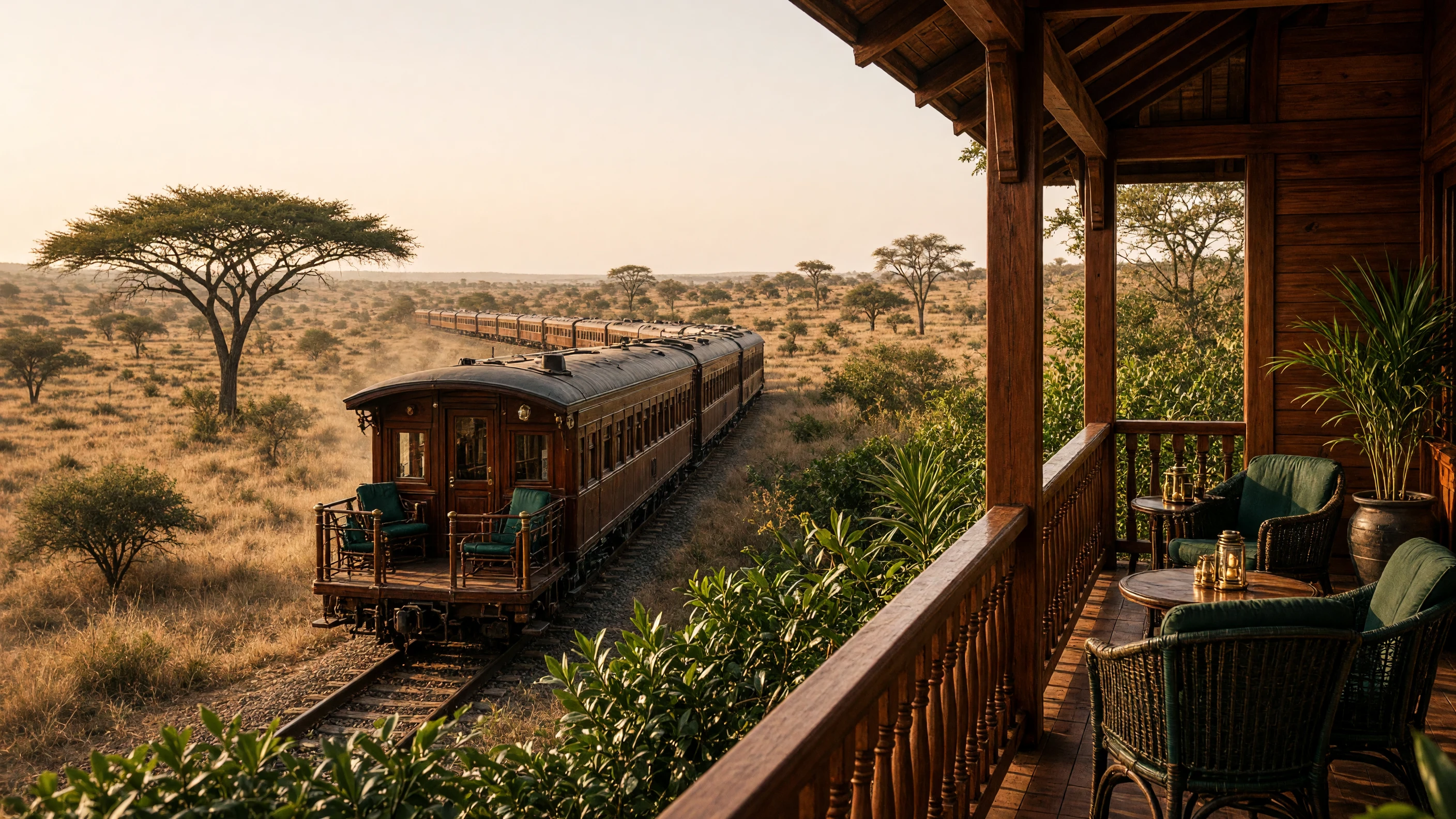
The departure board at Pretoria's Capital Park station lists a 15:00 departure for the reserve siding at Rooiwal, and by 14:40 the platform has filled with people in linen. The train is a shade over three hundred metres long once the locomotive is coupled on, which is long enough that the passengers at the front can't see the observation car at the back. Eleven carriages, a diesel locomotive, a route that spends its first hour threading through the industrial edge of the city before the bush opens up: this is what luxury African safaris by train look like from the ground.
Rovos Rail rebuilt these carriages from scrap. That's the story the company tells, and the evidence sits in the lounge cars, where the teak panelling has been restored to a depth of finish you rarely see on a moving vehicle. The seats are deep, the windows are large, and the air conditioning runs at a temperature that suits a jacket. Murray, who has worked the Pretoria to Rooiwal run for nine years and checks tickets at the carriage door with a handheld scanner, says the average passenger asks two questions before the train moves: where the animals are, and whether there's a plug for a phone.
There is. Each compartment has a socket, though the voltage dips when the train is climbing, which happens more often than the timetable suggests.
The first stretch of the journey is genuinely dull. The line out of Pretoria passes warehouses, a scrap yard, and a stretch of track where the train slows to walking pace for a curve. Nobody on the observation deck says much during this part, and a few people go back inside. I'd count that as useful information rather than a complaint: the safari doesn't start until the train has cleared the city limits, and the two hours before that are better spent in the dining car with a pot of tea.
By mid-afternoon the landscape has changed. The bushveld arrives in stages, first as scrub and then as something denser, and the observation car at the rear of the train becomes the most popular place on board. It's open-sided, with a low railing and a row of chairs that face backwards, so the view recedes rather than approaches. That backward perspective takes getting used to. Behind you is where you've been, not where you're headed. The effect is oddly calming, and it's also the reason the observation car empties out at dusk: there's nothing to see behind you once the light goes.
Dinner is served at a fixed hour, in a dining car with white cloths and a menu that changes nightly. The kitchen turns out four courses from a galley smaller than most people's bathrooms, which is a fact the staff mention with some pride. The food is good rather than remarkable. What makes the meal is the setting, the fact that the train is moving, and the particular silence that falls over a carriage when the sun drops and the bush goes dark on both sides.
Then the train stops for the night.
That's the compromise at the heart of this kind of trip, and it's worth describing plainly. A sleeper train that keeps moving through the dark can't offer a game drive at dawn, because the animals and the track don't line up that way. So the train pulls onto a siding, the locomotive shuts down, and everyone sleeps in a stationary carriage. In the morning, before breakfast is cleared away, the game vehicles arrive from the adjoining reserve and take passengers out for three hours.
The reserve covers just over 18,000 hectares, which is small by the standards of the big public parks and large enough that you won't see the same waterhole twice. The morning drive I joined covered eleven kilometres in three hours, which gives you some idea of the pace. We saw a herd of elephant at a distance, a pair of rhino that the guide identified before I could find them in the bush, and a great deal of nothing, which is the honest arithmetic of game viewing anywhere. The guide, whose name I've written down as Daniel and may have misheard, knew the reserve well enough to predict where the elephant would cross a track. They crossed it twenty minutes later.
Back on the train, breakfast is served as the locomotive pulls away. This is where the format earns its keep. The morning drive ends, and rather than a two-hour drive back to a lodge, there's a shower, a hot breakfast, and a window seat. By eleven the train is running again.
Somewhere in the second afternoon the train crosses a river I didn't catch the name of, wide and brown and slow, and everyone drifts to the windows without being told. Nobody says anything for about a minute. The bridge takes forty seconds to cross at the speed the train is doing.
The suites are the part of the journey that most people have already seen in a brochure, so I'll keep this brief. They're compact, paneled in wood, with a double bed that folds away during the day and a small bathroom with a shower that works better than the pressure at some hotels I've stayed in. The deluxe cabins have more floor space and a separate lounge area. I booked the standard and didn't feel shortchanged. There's a writing desk, a fan, and a window that opens partway. The whole thing is about 5 square metres.
What I hadn't expected was how much of the trip you spend sitting. There's the observation car, the dining car, the lounge, and the compartment, and moving between them takes up a pleasant amount of time. A few passengers had brought books and barely left their seats. Others treated the corridor as a social space and worked through the whole carriage by the second evening. The atmosphere leans formal: most people dress for dinner, and the staff set the tone.
The game viewing is confined to the early morning, and it's the shortest part of the day. Anyone booking with the expectation of a week of animals will be surprised by the proportions: it's mostly about the train, and the animals are the punctuation.
A note for anyone planning. The dry season, roughly May to October, gives better visibility and colder mornings than you expect; I didn't pack a heavy jacket and regretted it on the first game drive at dawn, when the temperature on the open vehicle sat at about four degrees for the first hour. Thermal layers aren't a glamorous purchase, and that's the point.
What the middle day on a luxury rail safari actually looks like
The middle day of the three-night itinerary is the best of them. The train covers a long stretch of the lowveld between two siding stops, and the afternoon passes with the observation car to yourself, a drink on the table beside you, and the light doing the thing it does at that hour. On my second afternoon I kept a note of what went past: a water tower, a cluster of cattle, a man on a bicycle who waved, and a field of something yellow that I couldn't identify. That's the pleasure of it. Not the tick-list, but the unremarkable sequence of things passing at a speed that lets you look at them.
The service is constant and unobtrusive. Your bed is made while you're at breakfast and turned down while you're at dinner. A steward whose name I never caught, and whose face I'd recognise in a crowd, remembered on the second morning that I liked my coffee black, which is a small thing that most places get wrong.
Nobody I spoke to had done a safari this way before. Most had done a lodge and a couple of flights and were curious. A retired couple from Perth said the appeal was the enforced idleness, which is a fair description; you can't hurry a train. For a more organised version, it makes sense to combine a short rail leg with a longer stay at a reserve camp, using the train as the transit rather than the main event. That arrangement suits people who want the animals front-loaded and the scenery in the gaps.
On the last night, dinner ran to four courses and a bottle of a Stellenbosch red that I can't name, because I didn't write it down. The train had one more stop before Pretoria, a siding where nobody got off. The locomotive idled for about half an hour while the crew did something at the front, and the whole train sat quiet in the dark. Nobody minded. Everyone in the dining car had a glass and a window, and the night outside was doing its thing.
The staff hand out a printed timetable on the morning of arrival, on cream card, with the company crest at the top. I still have mine.