

Luxury Bush and Beach African Safaris: A Real Guide
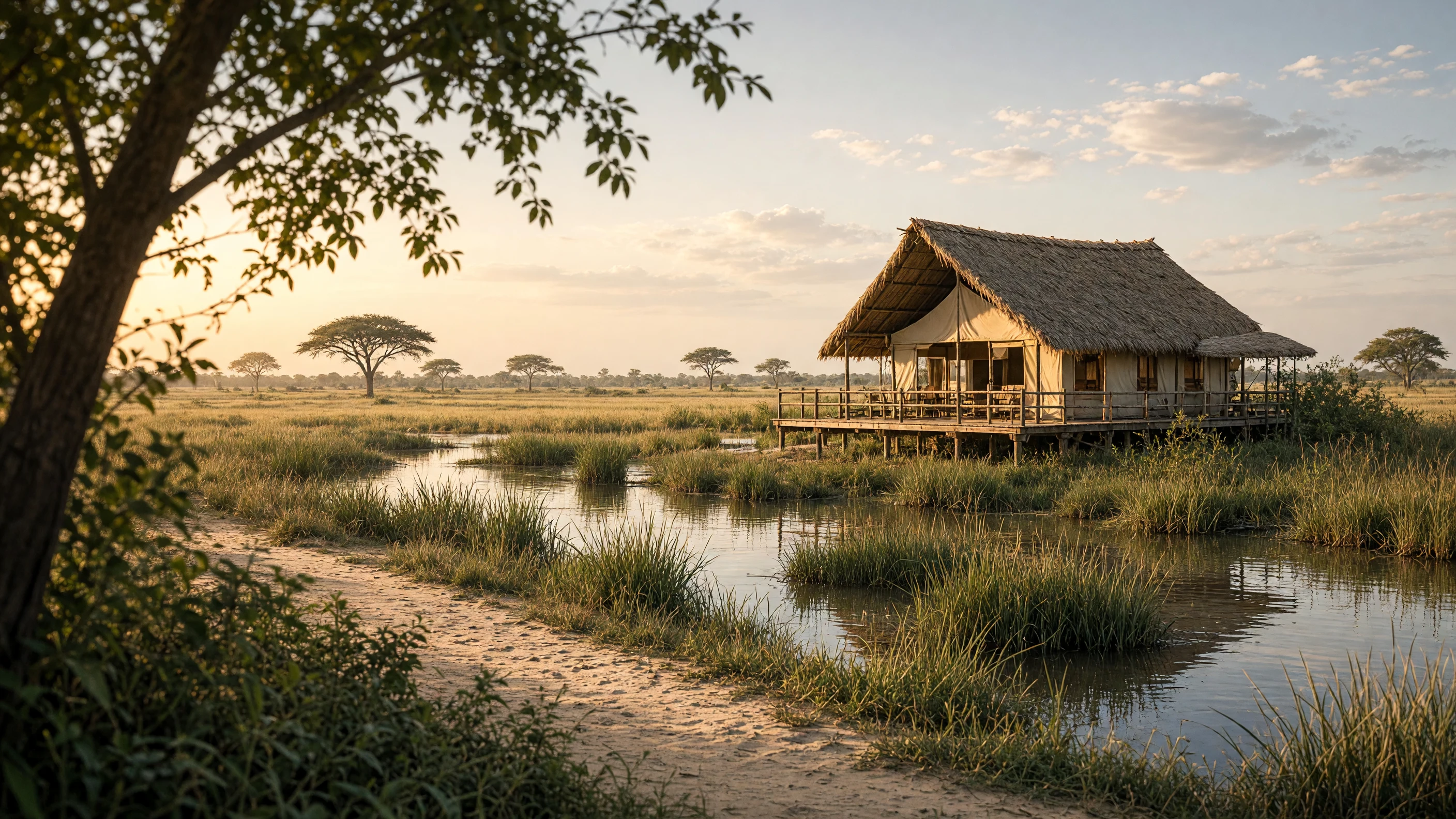
The lodge laundry returns your shirt at six the next morning with a note pinned to the collar saying it has been washed twice, and it still smells of woodsmoke. The split between the two halves of a luxury bush and beach African safari isn't a marketing split; it's a laundry problem. You'll spend the bush half in clothes that never quite dry and the beach half in clothes that dry in twenty minutes and then stiffen with salt.
Most itineraries run four nights in the bush, three at the sea, and charge between about £900 and £1,600 a night per person, with single supplements that sting. Whether that figure holds depends on season and camp tier, so treat it as a bracket rather than a quote. I've met people who paid less and people who paid a great deal more, and the difference had less to do with thread count than with how far from the nearest airstrip they ended up.
What the luxury actually consists of
Not marble bathrooms. A plunge pool the size of a bathtub, yes, and a tented room with a fan that runs all night on solar, and a bed you can hear the hippos from. But the thing you're paying for is a guide who knows where the wild dogs denned last week, and a vehicle with only four passengers in it instead of eight. Game density per vehicle matters more than thread count. A camp that caps guests at four per row of seats will always beat one that doesn't, whatever the chandeliers.
You'll notice the difference on the first drive. In a crowded vehicle someone at the back can't see, and the guide spends half the morning repositioning. In a good one, your guide stops, switches off the engine, and everyone listens.
A note on the fan: it hums at a pitch that took me three nights to stop hearing. Bring earplugs. The bush is quieter than you expect at midday. It gets much louder at 4am, when the francolins start, and then the vervet monkeys, and then someone's kettle.
Where the two halves fit together
The usual pairing puts you in the Okavango Delta or the Sabi Sand for the game, then a light aircraft or a road transfer to the coast. In Botswana, that's often the Okavango down to Maun, then a hop to the Bazaruto Archipelago off Mozambique, or down to the Cape. In South Africa, you can drive from the Kruger area to the Indian Ocean in about five hours if the roads behave, and they often don't. My transfer once took seven because of a truck on its side near Komatipoort. Nobody minded much. There were biscuits.
If you're crossing into Mozambique, check the visa arrangements for your passport before you book anything. Rules shift and the camp will know the current position better than any website, including this one. I'm not certain the e-visa system is running smoothly at every border post at the time of writing, so ask twice.
The beach half tends to be either the Indian Ocean side, warm water and reef, or the Atlantic side, cold water and no reef to speak of. Go Indian if you want to snorkel without a wetsuit. The Atlantic will give you dramatic empty beaches and a sea that takes your breath away in the literal sense. Both work. They are not interchangeable.
Bugs, boring drives, and the parts nobody photographs
Tsetse flies in the Okavango in the wet months will find the one patch of skin you missed. The repellent that works best contains DEET and smells like a hardware shop. You will get bitten. Bring antihistamine cream.
There's also the boredom. Not every drive delivers a leopard. Some deliver impala, impala, and more impala, plus a guide scanning the treeline for forty minutes while you sit in the heat with a warm water bottle. This happens often, and anyone who tells you otherwise is selling something.
The drives themselves are cold. A dawn game drive in an open vehicle in June in the Kalahari will have you in a fleece, a scarf, and a blanket the camp provides with a hot water bottle inside. By ten you'll be in a t-shirt. Pack layers and don't argue with the ranger when he hands you the blanket.
Oh, and the pool at the first camp had a frog in it. A big one. It stayed for two days. Nobody removed it. The camp manager said it had been there since November and named it Brian.
The beach half isn't frictionless either. Sand gets into everything: the book spine, the phone charging port, the small of your back. If you're diving, the boat rides out to the reef can be bumpy enough to make you reconsider breakfast. And the tides dictate your day more strictly than any lodge schedule. Low tide means you walk out and look at things. High tide means you swim or you don't.
Choosing a camp without being silly about it
Three questions will tell you more than the brochure. How many guests per vehicle? Is the guide a permanent employee or a freelancer on rotation? And what's the water situation in the season you're travelling, because a camp that's all dust in September might be a swamp in March.
Ask about walking safaris too. A morning on foot with a guide and an armed ranger is slower, quieter, and more unnerving than anything you'll do from a seat. You'll be told not to talk. You'll talk anyway.
The rest of it, the copper bathtubs and the turndown gifts of beaded bracelets, doesn't change your experience one bit. It's nice. It's not the point. What you're really buying is proximity and expertise, and a guide who can read a spoor in the sand and tell you it's a female leopard with cubs moving east.
You should also know what you won't get. No camp will guarantee you a leopard, a rhino, or a wild dog, however much you've paid, and any operator who hints otherwise is being loose with the truth. Some of the best mornings I've had involved almost nothing: a secretary bird stomping a snake, a lone elephant bull stripping bark, and coffee from a thermos that tasted of plastic.
And you'll do a lot of waiting. Waiting for the plane, waiting for the tide, waiting for the lions to move. Bring two books. Bring a third.
What luxury bush and beach African safaris cost in practice
Take a ten-night trip. Four nights bush at a mid-to-upper camp, three nights beach, three nights split between a city and a transfer. Flights within Africa are usually extra, often £250 to £600 per hop, and there are several hops. Park fees and conservancy fees add another £30 to £80 a night in some areas, and they're frequently quoted separately, which is annoying but standard.
You'll pay a premium for a private vehicle if you want one. It's worth it if you're a photographer with a long lens and no patience. It's not worth it if you're happy to share and chat.
Some camps include drinks, some include only house wine, some charge for the good gin. Read the inclusions page twice. I've seen a bill at the end of a week that turned a comfortable budget into a clenched-jaw moment, and it was entirely down to imported whisky and one spa treatment.
Gratuities are another line. Budget £10 to £20 a day for guides and general staff, more for a private guide. It's not compulsory. It is expected. Do it in cash, in local currency where you can, and hand it over personally rather than in an envelope at reception.
Packing that actually works
- Two pairs of trousers, one of them quick-drying, one of them for dinner
- A fleece and a light down jacket for dawn drives, even in summer
- Neutral colours, but not white, because dust
- Binoculars. Buy a pair. Don't borrow.
- Earplugs, eye mask, and a torch small enough to keep by the bed
- Antihistamine, rehydration sachets, and a proper sun hat with a chin strap
- A dry bag for the beach half, and a spare battery pack for the long transfers
Skip the safari-themed shirts. Half the vehicle will be wearing them.
The bit where you slow down
Around the fifth day, the early rising carries over from the bush half to the coast. You'll wake at five on the beach without an alarm and wonder why the room is so quiet. The sea does the job the bush did: it makes you small and stops you checking your phone.
That's the thing about combining the two. The bush gives you tension and attention, the coast gives you slack. The bush demands you look. The coast lets you not look at anything in particular. You need both, I think, to come home properly rested rather than just impressed.
Which isn't to say the pacing always works. If you put the beach first, you'll spend it anticipating the bush. If you put the bush last, you'll be too tired to enjoy the sea. Bush first, then beach. That's the order.
Take a rest day in the middle. Don't book an activity. Sleep in, eat a long lunch, and let the afternoon go nowhere. It costs nothing and almost nobody plans for it.
Book it yourself or use someone
You can book the pieces separately and save money, provided you're comfortable arranging light aircraft transfers on WhatsApp with a man named Piet. Many people do. Others use an operator who'll handle the whole chain and take a margin for the trouble, and there's no shame in that.
The advantage of an operator is that when the airstrip floods, or a charter cancels, someone else is on the phone at 5am. The disadvantage is that you'll pay for the convenience, sometimes 15 to 20 per cent. Weigh it against your tolerance for improvisation.
Whatever you choose, book the bush camps first. They fill earlier than the beach lodges and the good guides get allocated by season. The beach will still be there.
One last thing: the small plane from Maun to the delta has a baggage limit of 20kg in soft bags, and they mean it. I watched a man repack a hard-shell case onto the tarmac in 34 degree heat while his wife looked at the horizon. He made it. The case didn't.
On the final morning at the coast, a boy walked past the loungers selling cashews roasted in a paper cone for the equivalent of 80p, and the smell of them lasted longer than the flight home.
Further reading: Safari on Wikipedia.