

Luxury Family Safari Holidays in Africa: Expert Guide
You land at a small airstrip in the Okavango Delta just after four in the afternoon, and by five you're watching a herd of elephants file down to a waterhole below the deck where your children are eating ice cream. Your family is on safari. Nothing about the day has been rushed, and nobody has had to carry anybody else's bag.
Exploring luxury family safari holidays in Africa has changed a good deal in the past decade. Camps that once quietly discouraged children now court them with bush walks, tracking lessons and a dedicated kitchen that will produce plain pasta at any hour. The changes aren't cosmetic. They make the difference between a trip your family endures and one it talks about for years.
Why a private guide changes the family safari
The single biggest upgrade you can buy isn't thread count or a plunge pool. It's a vehicle and guide reserved for your family alone. With a private guide, the day fits around your children's energy rather than the other way round. You can leave at six, come back at nine for a proper breakfast, and head out again mid-afternoon when the light goes golden. Or you can abandon the second drive entirely because someone has discovered the camp's resident tortoise and won't be moved.
Private guiding also means the commentary is pitched at the right level. A skilled guide reads the car. He will explain a lion's tooth wear to a nine-year-old and the territorial dynamics of the pride to you, in the same five minutes, without patronising either party.
You'll pay for the privilege. Expect a private vehicle to add between £350 and £600 a day depending on country and season, and in peak July weeks on the Botswana circuit that can climb higher. If your party numbers four or more, the maths often works out close to what you'd spend on two shared seats anyway. For a family of five, it's almost always the right call.
Choosing camps that genuinely welcome children
Every lodge in Africa claims to be family-friendly. Fewer mean it. The ones that do will tell you the minimum age for game drives (usually six), the age for walking safaris (sixteen at most camps, twelve at a handful), and whether they run a children's programme in the school holidays only or year-round.
Ask specific questions before you book: how many families are in camp at once, what happens to children during the adults' evening meal, and whether the family rooms have a proper dividing wall or just a curtain. That last one matters more than you'd think after a long day in the sun.
South Africa's private reserves in the Sabi Sand and Madikwe tend to be the easiest entry point. Malaria-free Madikwe, in particular, suits first-time safari families with young children, and the drive from Johannesburg is four hours on good tar or a forty-five-minute charter. Kenya's Laikipia plateau and the Mara conservancies offer a wilder feel with excellent family houses that come with their own staff, kitchen and pool. Botswana is the most expensive and the most rewarding, with camps that keep child numbers deliberately low.
Tanzania's northern circuit works well for older children, especially if you combine it with a few days on Zanzibar at the end. Namibia rewards patience and a tolerance for long drives; the dunes at Sossusvlei are best saved for children over ten who can handle a 5am start.
What a typical day actually looks like
The rhythm is gentler than most parents expect. You're woken at half five with coffee and a torch, because the generator is off and the paths are unlit. By six you're in the vehicle with blankets, hot water bottles in winter and a flask of cocoa for the small ones. The first two hours are the best of the day: lions finishing a kill, wild dogs setting off, the light coming sideways through the acacia.
Back at camp around nine, breakfast is unhurried. Eggs, fruit, a tower of toast, and a chef who will make whatever a fussy seven-year-old demands. Then the middle of the day is yours. Most camps have a pool, a library and a shaded veranda with a view. Some run bushcraft sessions where children learn to make fire with a bow drill or identify tracks in a sand pit. Our daughter spent two hours learning to throw a knobkerrie with a guide named Solly and still talks about it.
Afternoon tea is at half three. The second drive runs from four until just after sunset, when you stop for drinks on the hood of the vehicle and the guide produces a tablecloth from the back of the Land Cruiser.
Children remember the small things: the elephant that walked past the pool at lunch, the dung beetle that rolled its ball the wrong way, the guide who let them hold the spotlight.
What it costs, and what you get
Luxury family safari isn't cheap, and it's fair to be clear about the numbers. An all-inclusive camp night in Botswana's Okavango will run from £900 to £1,800 per adult per night in high season, with children often at half price or in a reduced-rate family room. Kenya is typically £600 to £1,100 per adult per night. South Africa's private reserves sit between £450 and £900. These figures include accommodation, all meals and drinks, laundry and two game activities a day.
Then add flights. Return from London to Maun or Nairobi runs £700 to £1,200 in economy, considerably more in the front cabin, and the light-aircraft charters between camps add £250 to £500 per person per hop. A ten-night family trip for four in Botswana in July will land between £28,000 and £45,000 all in. Kenya comes in a shade lower, South Africa lower still.
What you're buying at that price is expertise, mostly. Guides who have spent fifteen years in the same concession and know where the leopard will be at four o'clock. Trackers who have learned to read a print in sand the way you read a road sign. A camp manager who notices your son is nervous of the dark and quietly arranges for a lantern to be left on the path.
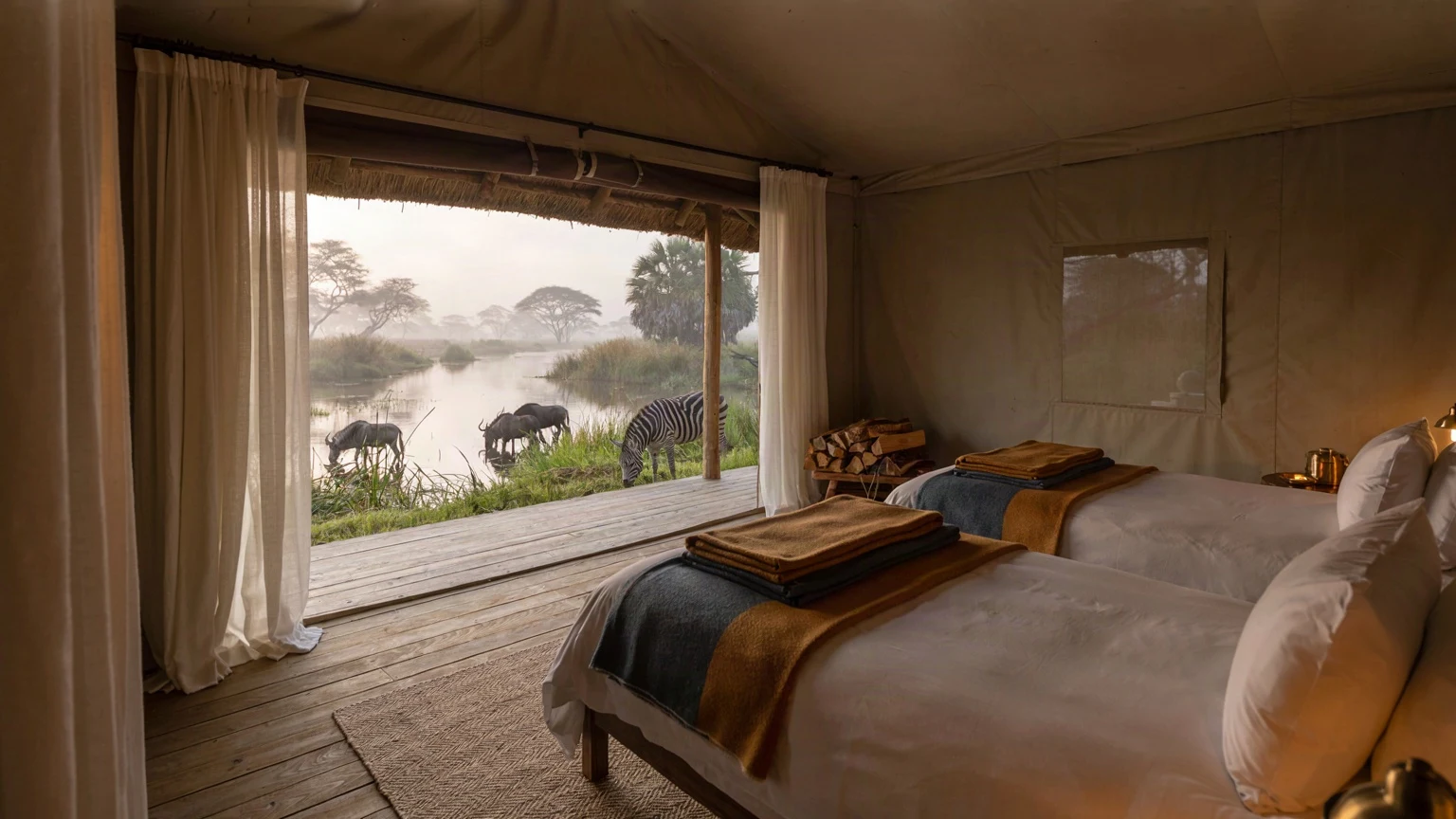
The family rooms themselves tend to be more considered than the brochure photos suggest. Canvas walls on a raised deck, two beds behind a proper partition, a fan that actually works, and hot water that arrives within a minute of your turning the tap. Small things, but you notice them on the fourth night.
The practical details worth knowing
Malaria tablets divide opinion. Botswana's Okavango and the Sabi Sand are low-risk, and many family doctors won't prescribe for children under a certain weight. Madikwe is malaria-free and removes the question entirely. Talk to a travel clinic six weeks before you go, not six days.
Packing is simpler than you'd imagine. Neutral colours, layers, a warm fleece for the morning drive even in summer, and closed shoes. Binoculars for each child; the cheap ones are fine. A head torch each. A small notebook, which most children fill within two days.
Yellow fever certificates are required for entry into South Africa if you've transited through a risk country, and the rules change. Check the current guidance for your route. Insurance should cover medical evacuation by air, which a good policy will include as standard.
- Best months for families: July and August for school holidays, though it's peak price. Late May and early September are quieter and cheaper.
- Minimum ages: six for game drives at most camps, twelve to sixteen for walking safaris.
- Flight connections: Johannesburg to Maun is under two hours; Nairobi to the Mara is forty-five minutes by light aircraft.
- Vaccinations: routine jabs plus hepatitis A and typhoid for most safari countries.
One small caution on the light aircraft. Luggage is limited to 15kg per person in soft bags, and on some routes to 20kg. You will not need more. Everyone overpacks the first time.
Combining safari with something else
Ten days of safari is too many for most children under twelve. Six nights in the bush, then four on a beach or in the Winelands, works far better. Zanzibar is a two-hour flight from the Serengeti's airstrips. Mauritius and the Seychelles connect easily from Johannesburg. Cape Town offers beaches, penguins at Boulders and the cable car up Table Mountain, all within an hour of a very good hotel.
Families with teenagers often add a night or two in Nairobi for the elephant orphanage and the giraffe centre, which sounds twee and isn't. Watching a twelve-year-old feed a giraffe from a raised platform is worth the detour.
It rained on our last morning in the Delta, a soft grey drizzle that turned the dust to mud and sent the francolins quiet. We ate breakfast inside, played cards and missed nothing.
The camp dog, a lean ridgeback cross, slept through the whole of it on the step outside the kitchen door.