

Luxury Safari Holidays in Botswana: An Insider Guide
You land at Maun at twenty past two in the afternoon, and the heat coming off the tarmac is the first thing that registers. Then the smell of aviation fuel. Then the small plane waiting on the apron, a Cessna Caravan with a row of seats that have seen better decades. Exploring luxury safari holidays in Botswana tends to start like this: a commercial flight, a short hop on something much smaller, and a sudden, complete absence of anything resembling an airport terminal. Your bag is weighed before it goes anywhere near the plane. The limit is usually 20kg in soft-sided luggage, and they do mean soft-sided, because a hard case physically will not fit into the pod under the wing.
If that sounds like a restriction on your idea of luxury, it is. But it's a restriction that buys you something.
What the Okavango actually feels like from the air
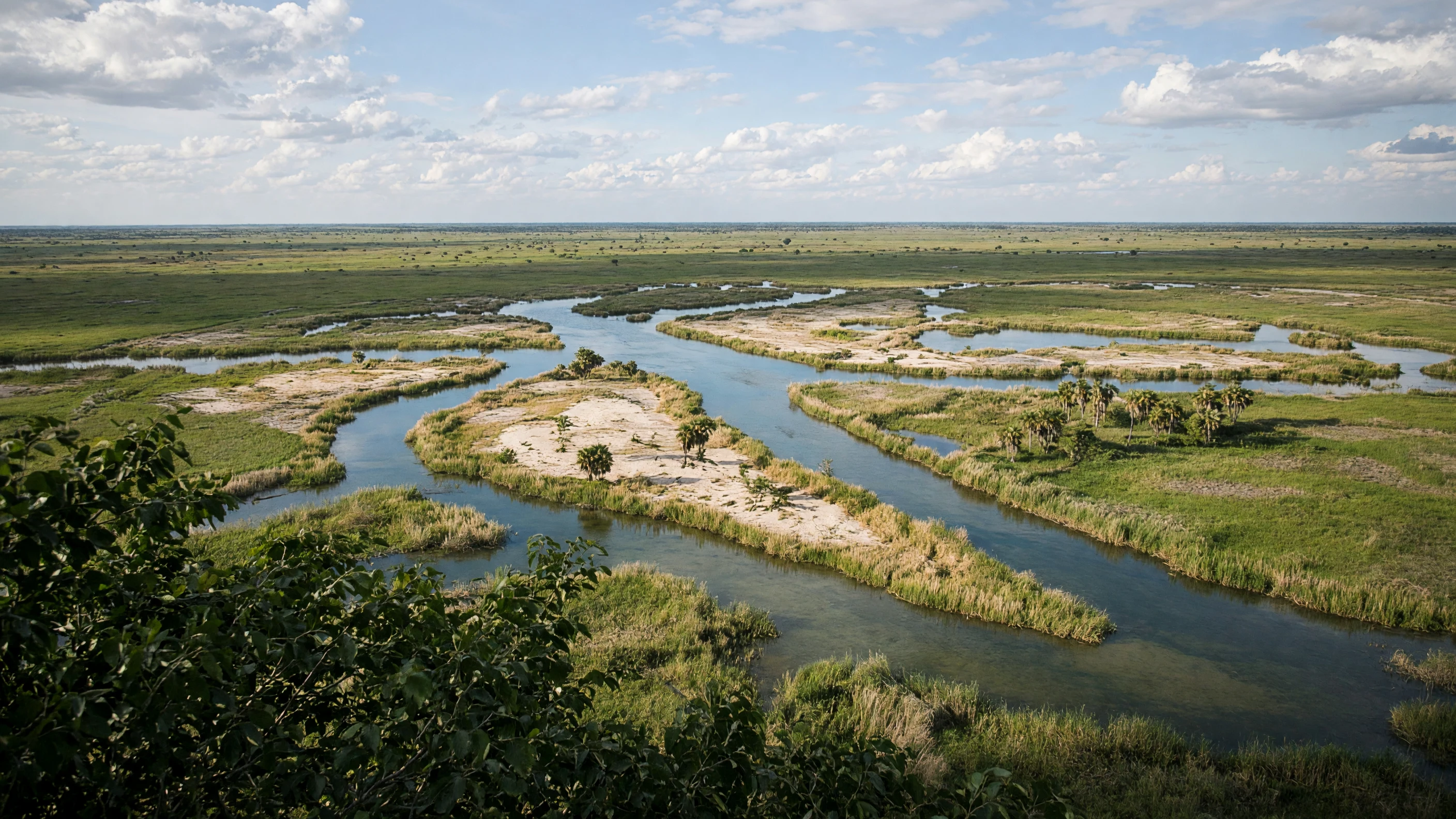
Twenty minutes after take-off from Maun, the ground below stops looking like land at all. Water channels fan out in every direction, cut by islands of pale sand and dry palm. There's no road, no fence line, no field boundary anywhere in sight. It's a river delta with no sea to drain into, which is why it looks the way it does, and it's the reason exploring luxury safari holidays in Botswana has become such a distinct thing: the landscape itself doesn't resemble East Africa's savannahs, and neither do the camps.
You'll land on a dirt strip that may or may not have a name board. A guide meets you in an open-sided Land Cruiser and hands you a cold towel that's been sitting in a cool box. The drive to camp takes anywhere from eight minutes to fifty, depending on the season and how wet the floodwater is. In a good flood year, you'll cross a channel where the water comes halfway up the doors. Nobody makes a fuss about this. It's just a Tuesday.
Camp itself is usually ten or fewer tents, which is deliberate: Botswana's government has licensed wilderness areas on a low-volume, high-cost model for decades, and operators have to meet minimum standards on everything from waste to vehicle numbers. So there's no minibus convoy. Two vehicles per sighting is often the cap. Sometimes you're the only vehicle for twenty kilometres.
What you're actually paying for
Rates at a well-run camp in the delta can sit between £900 and £1,600 per person per night in high season, and I'd guess that figure has crept up since I last checked, though I'd rather not pretend I've done the arithmetic this month. That covers accommodation, all meals, laundry, and two game activities a day with a guide and tracker. It doesn't cover flights, and the internal hops are eye-watering: a return light-aircraft transfer between Maun and two delta camps can add £600 to £900 per person, sometimes more, depending on how many stops the pilot is stringing together.
So the money buys fewer people, not more marble. You're paying for an empty landscape. At a camp on the western edge of the delta, the manager told me they turn away business rather than add a fifth vehicle to the morning rotation.
Breakfast is eggs, bacon, and a fruit plate that's been flown in. Dinner is three courses and a decent South African red. The tents have proper beds, hot water from a canvas bucket, and a flush toilet. What they don't have is air conditioning, or a lock on your door, or much of a door at all. This is not a complaint. It's just worth knowing that the ceiling of "luxury" here sits at a very comfortable, beautifully run camp with a 6am wake-up call, not a spa hotel that happens to have zebras outside.
When to go, and the trade-offs nobody mentions
July to October is peak. It's dry, the floodwater is at its widest, and animals concentrate around the remaining water. It's also when every camp is full and the rates are highest. You'll see a lot, and you'll see it alongside the maximum number of people the concession allows.
What you might not expect: January and February, the green season, are underrated. You get afternoon thunderstorms that last forty minutes, dramatic skies, and calving herds. Rates drop by something like 40 per cent. The catch is that the water levels dip, some roads become impassable mud, and the mosquitoes come out at dusk in a way that will test your patience. The light, though, is extraordinary. It's also when many guides take their leave, so you may not get the camp's most experienced hand.
Somewhere between those two poles sits the shoulder season of May and June, when the flood is arriving but the crowds haven't. I'd take that window over peak season and spend the difference on a few more nights.
The best camp isn't the one with the most stars in its description. It's the one whose guide knows when to switch the engine off and just wait.
Makgadikgadi and the salt pans: the other Botswana
The delta gets the attention, but the Makgadikgadi salt pans east of Maun are a separate landscape entirely: flat, blindingly white in the light, and silent in a way that's genuinely unsettling. You don't see water here. In the dry months you can drive out onto the flats and not see another soul for an hour. A few camps run quad-bike outings to see the resident meerkat colonies, which are habituated enough to climb on your shoulder if you sit still long enough.
There's also a marked contrast in the accommodation. The pans camps tend to be smaller, more fabric than wood, and more exposed to the wind. One night I slept through a gale, or rather I didn't sleep through it: the tent canvas snapped all night and my pillow was gritty with sand by morning. A minor inconvenience and a fair trade for the dawn. Not everyone would agree with me on that.
If you're flying between the delta and the pans, budget a full half-day for the transit, because light aircraft schedules are dictated by passenger numbers, not your plans. You'll wait at a strip in the middle of nowhere, and you'll be fine. Bring a book.
The camps: what to ask before you book
Ask how many vehicles per sighting they allow, and ask what happens if a guest wants to spend two hours with the same leopard. Ask how many guides they employ full time versus seasonally. Ask whether the camp is water- or land-based for game drives in the month you're travelling, because a "water camp" in a dry year becomes a bumpy drive camp, and nobody will tell you that at the time of booking. The answers matter more than the thread count.
Ask, too, about the average group size in a vehicle. Six is common. Four is better. Two is what you're paying for.
Mokoro trips are the other thing to ask about: a mokoro is a traditional dugout canoe, now usually fibreglass, poled by a guide through the shallows. You sit low, and the reeds are above your head, and the whole trip takes about an hour and a half. It's lovely and it's also uncomfortable after the first forty minutes, because there's no back support for however long it takes and you're not allowed to shift your weight much. Worth it anyway.
- Book at least six to nine months ahead for July to October. The best-value camps sell out first, which is not the same as the priciest ones.
- Check whether the quoted rate includes the conservancy or park fee, which in the delta's private concessions can add a meaningful sum per person per night.
- Find out the luggage limit before you pack, and don't assume your international carrier's allowance applies to the feeder flight.
- Take binoculars. Camps lend them, but they're often spoken for.
- Bring a head torch and spare batteries: the paths between tent and dining area are unlit, by design.
On the question of who runs the camp, I'd note that community-run and joint-venture camps in the Okavango and Chobe exist and are worth seeking out, though the quality varies and the booking process can be opaque. You won't find them all on the big aggregator sites. It's a limit on what I can tell you with confidence: I haven't stayed at enough of them to rank them fairly.
Two things to get right before you go
First, insurance. Standard travel policies often exclude light aircraft and game activities. Check the small print, or ask a specialist. A helicopter evacuation from a delta camp to Maun costs thousands of pounds, and a policy that covers it is cheap relative to the risk.
Second, health. Malaria risk varies by area and season, and you should talk to a travel clinic rather than a search engine. Take the appointment seriously. The delta in the green season is not the place to wing it.
The other thing people underestimate is the rhythm. You'll be woken at half five with tea through the tent flap, out by six, back by ten for brunch, asleep by two, out again at four, back for dinner at eight, in bed by nine. It's not a restful holiday. It's an early one. A few people find the schedule relentless; most find that by day three they've adjusted and the afternoons feel like a gift.
And the noise at night: you will hear things you can't identify, and you won't be allowed to walk to the bathroom alone after dark. A guide accompanies you with a torch. This is not a joke and shouldn't be treated as one. It's also the reason you're here.
A note on the light and the waiting
Guides talk about patience the way fishermen do. The best sighting I've had in Botswana involved an hour and forty minutes of sitting still beside a dry channel, watching nothing at all, before a female leopard walked past at about eight metres and didn't so much as glance at us. You can't plan that. You can only be in a camp that lets you sit still without a radio call dragging the vehicle off to a "better" sighting. Choosing the right camp is mostly about choosing the right kind of patience. It's the same thing, the camp and the patience: the whole point of the place is that it permits waiting.
Which brings you back to the money. You are not paying for a guarantee of anything. You're paying for time in a place where nothing is scheduled except your meals, and where the most valuable skill in your guide is knowing when to turn the engine off.
Practicalities, then: the internal flight from Maun to a delta camp takes around twenty-five minutes, and your seat is not assigned, so sit on the left if you can. You'll see more water. Nobody will tell you this at the desk, and the pilot may move you anyway for weight and balance. Also, check that the light-aircraft operator is included in your travel insurance before you book, because some international policies quietly exclude it and you won't discover that until a claim. That's the sort of thing that matters more than the thread count.
Finally, the small matter of the flights home. Most itineraries route you back through Johannesburg, which means a night in an airport hotel if your connection is tight. Book the onward flight for the following morning rather than the same evening, and use the spare hours to eat something that isn't a buffet. A plate of peri-peri chicken and a cold beer at a restaurant near the airport, and you're done.
Further reading: Safari on Wikipedia.